TEAM PROJECT · 5 PEOPLE
3D Top-Down Time-Manipulation Action Game
Unity · Game Design · Combat Design · Level Design · Narrative Design
PROJECT TYPE · 5-PERSON TEAM PROJECT · 3D ACTION GAME
ENGINE
Unity
TEAM SIZE
5
MY ROLE
Game Designer
A 3D top-down action game inspired by Katana ZERO. Players slow time, dash, use melee attacks, parry bullets, and throw objects to assess threats, sequence actions, and clear levels in fast combat.
TEAM & MY ROLE
Team: 3D Artist / Producer · Game Designer · Programmer · 2D Artist · Sound Designer
As the game designer on a five-person team, I led the overall design direction: early level concepts, level whiteboxing, player mechanics, enemy mechanics, boss mechanics, progression and encounter design across five levels, plus parts of narrative and experience integration.
Throughout development, I worked closely with programming, art, and audio to carry gameplay, level, and experience direction into the final build.
OVERVIEW
Slash Time is a 3D top-down action game built around fast decisions, short combat loops, and time manipulation. Players read enemy distribution and attack rhythm, use different abilities to resolve threats quickly, then adjust routes and attack order after failure.
DESIGN PILLARS
Fast Decisions and Execution
Players quickly assess enemy position, attack direction, and threat priority, then act on that information.
Time Abilities Change Combat Tempo
Slowing time reduces execution pressure while giving players a window to reread the battlefield and plan their next action.
Space and Enemies Create the Challenge
Level layout, enemy archetypes, placement, and attack direction shape combat routes, prompting players to find solutions through movement and target priority.
PLAYER MECHANICS
Slow Time
Players can actively slow time to observe enemy attacks, reposition, and plan the next action.
Attack · The core close-range tool for quickly dispatching enemies.
Bullet Parry · A precisely timed attack can reflect enemy bullets, turning ranged pressure into a counterattack opportunity.
Dash · Reposition quickly, evade attacks, and close distance to a target.
Pick Up & Throw · Pick up interactive objects in the environment and throw them for an additional situational combat option.
ENEMY READABILITY & SUPPORT DESIGN
Because Slash Time moves quickly, enemies need to create threat while keeping combat readable. Alongside enemy attack patterns, I added attack prediction and aim assist to help players identify danger sources, attack direction, and target position.
01 — ENEMY ATTACK PREDICTION
Before attacking, enemies provide predictive information so players can identify the incoming direction and danger area. In fast combat, this reduces unpredictable hits and gives Slow Time, Dash, and Bullet Parry clearer moments of use.
READ → PREDICT → REACT

02 — AIM ASSIST
With a 3D top-down camera and fast movement, players need to confirm their current target quickly. Aim assist reduces the input burden of target selection, freeing attention for routes, threat assessment, and timing.

03 — ENEMY ARCHETYPES
MELEE ENEMY
Melee enemies actively close distance to compress player movement and create close-range pressure.
On death, they drop weapons that can be picked up and thrown. This turns a kill into both threat removal and a new temporary combat resource.
RANGED ENEMY
Ranged enemies apply sustained pressure through projectile attacks, forcing players to dodge, close distance, or use Bullet Parry to reflect shots.
LEVEL PROGRESSION
Tutorial → Level 1 → Level 2 → Level 3 → Boss Level
↓
Detailed Boss Design Breakdown

01 — TUTORIAL
Introduces movement, attacks, Slow Time, Dash, and the game’s core combat rules.

02 — Level 1
Lets players apply learned fundamentals in full combat encounters.

03 — Level 2
Changes the perspective and delivers a distinct power-fantasy beat to prepare players for rising difficulty.

04 — Level 3
Combines learned abilities against more complex enemy configurations and combat spaces.
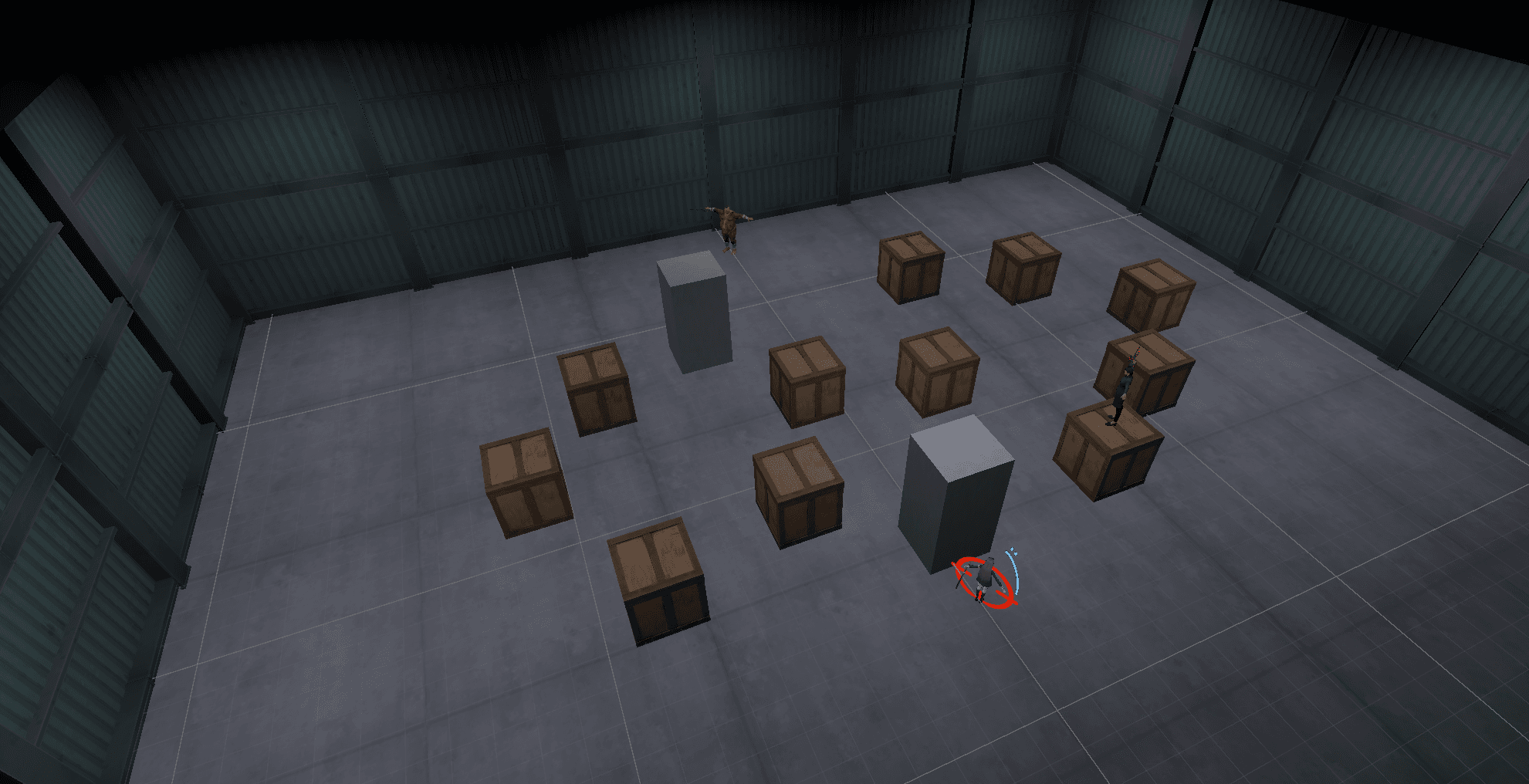
05 — Boss Level
Concludes with a standalone boss fight that tests player mastery of movement, attacks, time manipulation, and combat decision-making.
LEVEL DESIGN & WHITEBOX
Level design began with concept art and layouts, then moved into Unity whiteboxes to validate movement routes, enemy placement, combat space, and encounter pacing. Once gameplay was proven, I worked with the team to bring the whiteboxes into final environments.


BOSS DESIGN
The boss level closes the five-level progression. Compared with standard encounters, it repeatedly tests core abilities in a more concentrated arena, using boss mechanics, attack information, and space design to form a complete final challenge.
01 — BOSS DESIGN GOAL
The boss fight asks players to combine the core abilities introduced earlier—using Slow Time and Dash more precisely to observe, assess, and execute under greater pressure.
Slow Time · Dash · Attack · Bullet Parry · Movement / Positioning
02 — BOSS MECHANICS
Boss mechanics were defined early in the GDD, including attack logic, player-readable information, and corresponding counters, then adjusted through playtesting.
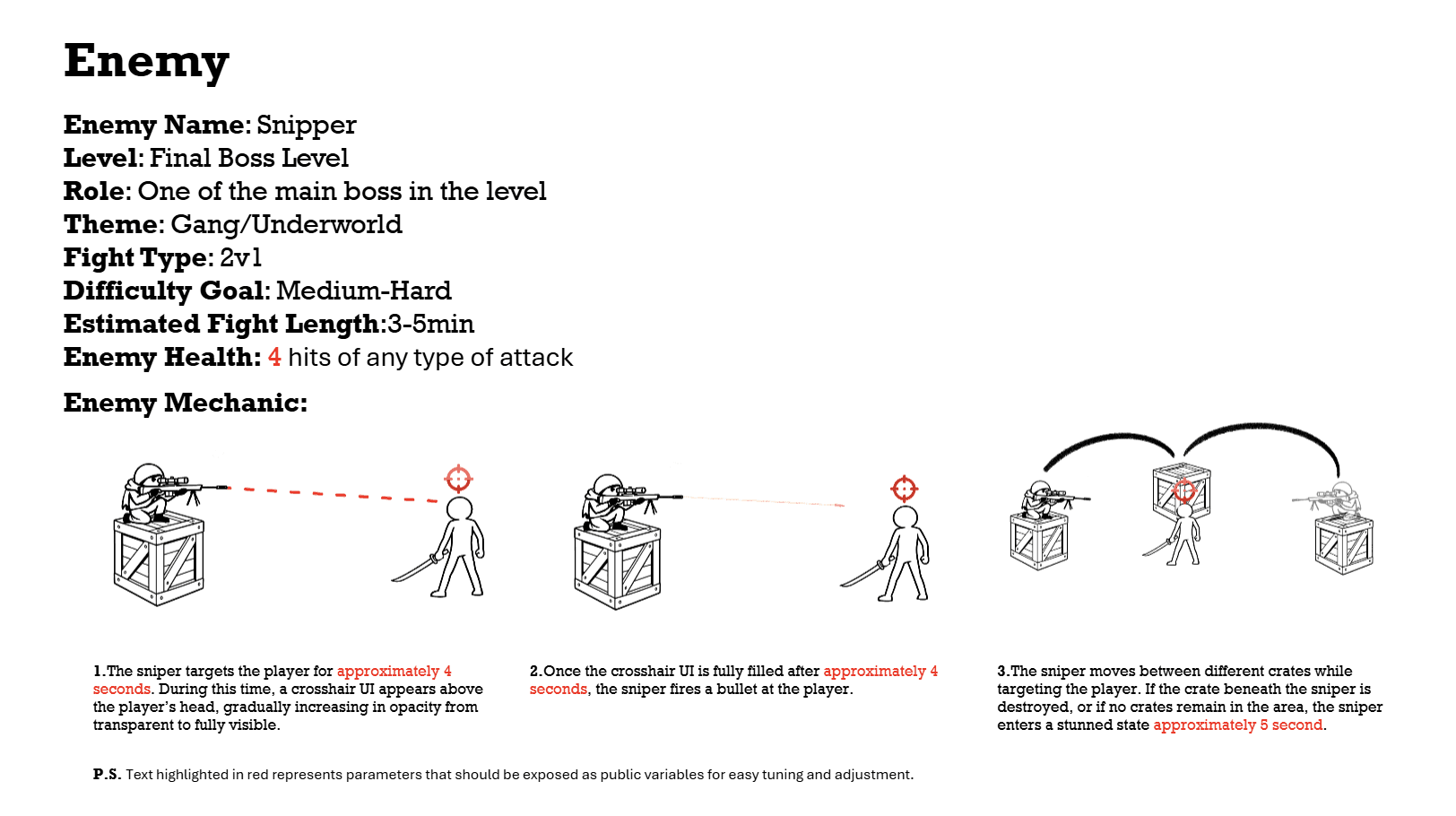

The design document defined mechanics for two bosses and environmental crates, then values were tuned with the programmer.
03 — BOSS ARENA
CONCEPT → FINAL


04 — PLAYER SKILL CHECK
Read Boss Behavior → Assess Attack Information → Use Slow Time to Create a Decision Window → Reposition Through Movement → Find a Counterattack Opportunity
NARRATIVE & EXPERIENCE
Beyond core gameplay and levels, I also contributed to the game’s overall experience and narrative direction, helping keep progression, combat pacing, and presentation cohesive.
MY CONTRIBUTION
As the game designer on a five-person team, I owned overall gameplay design, early level concepts, whiteboxing, player, enemy, and boss mechanics, progression and encounters across five levels, plus parts of narrative and experience integration. I collaborated with programming, art, and audio to bring the design into the build.
FINAL RESULT

The final result is a 3D top-down action experience built around time manipulation, fast movement, melee attacks, bullet parries, and thrown-object interactions, with player mechanics, combat encounters, and a boss challenge paced across five levels.
PREVIOUS PROJECT
ANIMAL WATCHER
BACK TO PROJECTS